


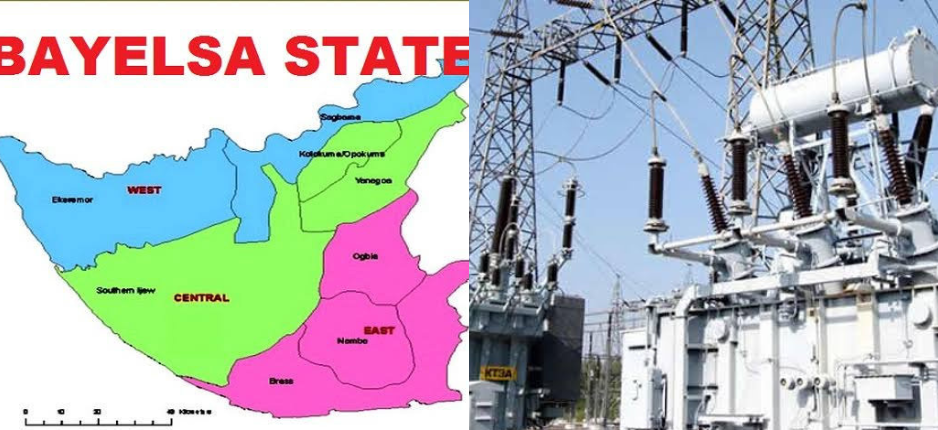
Bayelsa State has endured a crippling power outage for over four months, disrupting businesses and leaving homes in disarray.
The widespread blackout, which also affects parts of Ahoada in neighboring Rivers State, stems from the vandalism of critical power infrastructure.
The destruction of two 132KV transmission towers along the Owerri-Ahoada-Yenagoa power line on July 27, 2024, has been identified as the initial cause.
These towers are crucial for supplying electricity to the entire state. Since then, the state government, in partnership with the Transmission Company of Nigeria (TCN), has been striving to restore power, but challenges persist.
Escalating Vandalism Worsens the Crisis
Efforts to address the situation suffered a setback on August 12, 2024, when 13 additional transmission towers on the same line were destroyed.
The incident, first reported by the Youth President of Ukpeli Community in Rivers State, prompted TCN’s Managing Director, Sule Abdulaziz, to describe the vandalism as a "national disaster." He expressed grave concern over the growing frequency and scale of attacks on the company’s facilities.
As the TCN and Bayelsa State Government worked to repair the damage, another wave of vandalism struck on November 19, with thieves stealing cables, further delaying restoration efforts.
A Resident identified as Tari from Saptex street, Yenizuepie in Yenagoa, lamented the lack of progress. “Vandals strike because there’s no electricity to deter them. Without power, transformer oil and cables are being stolen daily,” he said, urging the government to expedite repairs.
Government Plans for Immediate and Long-Term Solutions
In response to the ongoing crisis, Governor Douye Diri’s administration is taking steps to address both immediate and future energy needs.
While embarking his annual leave on Monday, the governor outlined plans for a state-owned Independent Power Plant (IPP) featuring a gas turbine.
This turbine, a combustion engine powered by natural gas, will generate electricity to power homes and businesses.
Currently, the state relies on the 225-megawatt Gbarain Gas Plant in Yenagoa, which serves only a limited population.
This facility was designed with the potential to transition into a combined cycle gas turbine plant, enhancing efficiency.
Additionally, the Kolo Creek Gas Turbine Plant in Imiringi has since last year begun refurbishment, according to Deputy Governor Lawrence Ewhrudjakpo.
He emphasized the government’s commitment to leveraging Bayelsa’s abundant natural gas reserves to develop new power plants and foster energy-driven industries.
Mixed Reactions from Residents and Stakeholders
While government officials project optimism, skepticism abounds among residents. Discussions around procuring and installing new gas turbines have persisted for years, leading some to dismiss them as political rhetoric. Nonetheless, federal lawmakers, including Oboku Oforji representing Yenagoa/Opokuma Federal Constituency, have advocated for reviving existing power plants like Gbarain, which they believe could power the entire Niger Delta region.
As Bayelsa grapples with the challenges of restoring electricity, the state government’s push for a more sustainable and independent power infrastructure offers a glimmer of hope.
However, overcoming the persistent threat of vandalism and addressing public skepticism will be key to ensuring lasting energy solutions.