


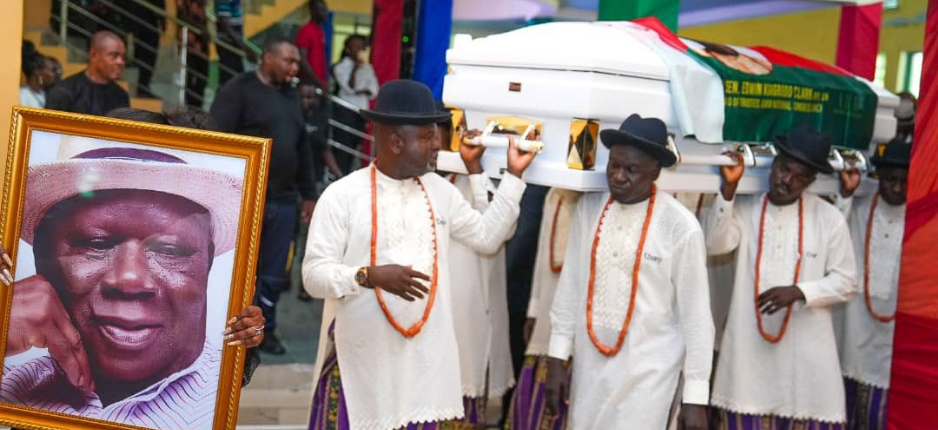
The remains of ijaw leader, nationalist, and activist, Chief Edwin Clark was laid to rest last week in his hometown of Kiagbodo in Delta State. It was the climax of a week-long funeral programme that took place in several cities, including Lagos, Abuja, Port Harcourt, Yenagoa, and Warri.
Born on May 25 1927, Chief Clark passed on peacefully on February 17, 2025, at the age of 97. He was a force of nature, an enigma and a colossus who bestrode every environment he found himself. He was a man known for his frankness, and at all times, he spoke the truth. He also spoke truth to power and was never afraid to challenge any perceived injustice.
Until he breathed his last, Chief Clark granted media interviews and organised press conferences. He was also known to be writing powerful open letters to register his displeasure over any misnomer. It was one of his own ways of starting his usual protest and in the process, drawing the attention of those in authority.
He was a committed patriot who loved his country and fought for it till the end. One of his protege and chairman of the Pan Niger Delta Fourm (PANDEF), Ambassador Godknows Igali, while giving an account of his last moment said he kept shouting "I am a Nigerian, I love Nigeria...".
The late Edwin Clark was well schooled, which empowered him with the requisite knowledge to perform creditably in all the public offices he held. His foray into politics began as a councillor for Bomadi in Delta State. That marked the beginning of his lifelong dedication to public service and the commencement of his leadership in advocating for the rights of his people.
He also served as a Federal Commissioner for Information, presently referred to as Minister of Information during the military regime of General Yakubu Gowon. He later emerged as a senator in 1983, under the National Party of Nigeria (NPN), in the short-lived second republic.
Chief Clark's audacity and bravery were unmatched. He was a very vocal man who was committed to his convictions. His activism became the hallmark of his life and career. He was a strong and vocal critic of corruption, poor leadership, and social injustice. His advocacy for true fiscal federalism and resource control was unwavering, earning him recognition as a champion of the Niger Delta region.
In 2005, during the Political Reform Conference, the elder statesman as leader of the South-South delegates led his team to stage a walk-out from the conference, over the rejection of 25 percent derivation fund proposed by the delegates for the oil producing states. That action was Clark's usual and unmistakable brazeness.
His fearless advocacy was not limited to his political career. It cuts across his entire life. His boldness in addressing critical national issues, particularly those related to the Niger Delta, was unparalleled.
Despite the fierce battle he had to face in protecting the rights of his people and other vulnerable members of the society, Clark never compromised his principled position. Whether confronting government officials on issues of critical national importance or advocating for the inalienable rights of his people, Clark was unrelenting in his pursuit of justice, equity, and fairness. He was all for an egalitarian society and never surrendered till the end.
When in 2015, Chief Clark officially bowed out of politics after over five decades, he committed himself more to activism as well as philanthropy. The elder statesman founded the Edwin Clark Foundation and established the Edwin Clark university in his hometown of Kiagbodo. The setting up of the university reinforced his love for education and his desire to provide young people with knowledge to face their future.
Nearing his exit, Chief Edwin Clark saw a reason to document his life, and that led him to author an autobiography titled “Brutally Frank." The 25 chapters and 688 pages book chronicled the journey of his life, starting from his ancestry, his roles as a politician, activist, and nationalist. To further and expand his advocacy, the deceased nonagenarian established PANDEF, a socio-political group.
Clark's love for the unity of Nigeria made his extend his wings across the Niger Delta, delving deep into the South-East and Middle Belt. As a Pan-Nigerian, he also had friends and associates in the far north and kept in touch until his demise.
The late Clark played a key role in negotiating the Presidential Amnesty Programme (PAP) for Niger Delta militants during the administrations of Presidents Umaru Yar'Adua and Goodluck Jonathan.
He went around the creeks of the Niger Delta, discussed with the militants, and convinced them to drop their arms and ammunition while assuring them of their safety and protection when they did.
Chief Clark's passing was the end of an era. It brought to a final halt a life of struggle for the good of the people he loved. He was unarguably a leader, a visionary, and a faithful servant of the people. Even in death, his influence will continue to shape the nation’s discourse, particularly on the things he stood, fought, and died for. His contributions to humanity will continue to resonate for generations to come.
He left behind a legacy firmly entrenched in the hearts of his people. His sojourn on earth was not only fulfilling but impactful. He left his big footprints in the sands of time, and the people of the Niger Delta, particularly the ijaws, need to begin the search for a new Edwin Clark. It is going to be an uphill task, but it has to be done.
Above all, the unity, peace, development, justice, and equity that he fought for needs to be sustained. Perhaps that way, he can finally rest in peace and accept the multitude and torrents of tributes and encomiums that have been showered on him. Adieu Chief Edwin Kiagbodo Clark!