


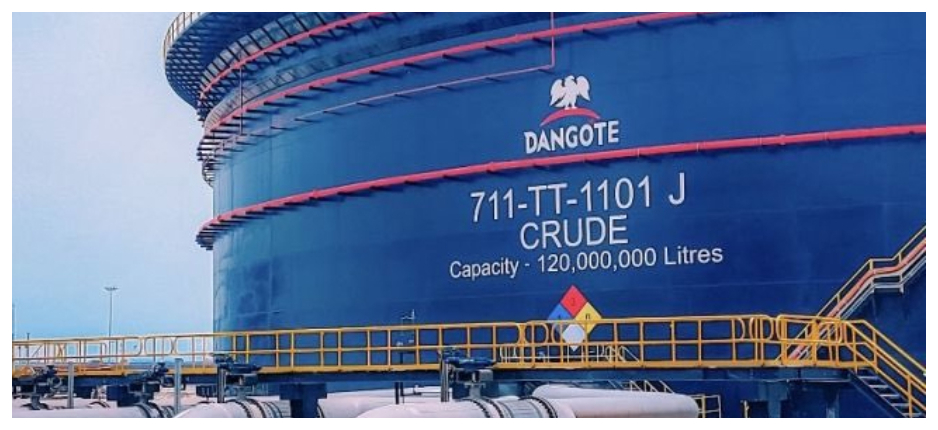
Nigeria's petroleum marketers have stated that the country cannot depend on the Dangote Refinery to meet its daily Premium Motor Spirit (Petrol) demand.
President of the Petroleum Products Retail Outlets Owners Association, PETROAN, Billy Gillis-Harry, revealed this on Monday, 16 September, 2024 to Daily Post in an interview.
He was addressing his members amid the Dangote Refinery Petrol Price Controversy and the impending pump price hike.
The Nigerian National Petroleum Company Limited (NNPC) on Monday announced a price list for Dangote Petrol at its retail stores across the country.
According to a statement by Olufemi Soneye, Chief Corporate Communications Officer, the company is currently purchasing petrol in dollars from the refinery for September, with sales in naira set to commence in October.
Consequently, the estimated cost price of petrol in Lagos, plus logistics, will stand at N950.22 per litre.
In other locations like Federal Capital Territory (Abuja), Sokoto, and Kano states, petrol will be sold at estimated prices of N999.22 per litre.
Rivers, Bayelsa, Akwa Ibom, Imo, and other states stood at N980, while Oyo State stood at N960.22.Lastly, the highest pump price will be in Borno State which stood at N1,019.22 per liter.
The NNPCL emphasized that PMS prices are not government-controlled but rather negotiated between parties on a commercial basis, by Section 206 (1) of the Petroleum Industry Act (PIA), which promotes arm's length transactions.
The price showed that petrol pumps will rise to around N950 and N1,019.22 per liter in NNPCL outlets.
While reacting to the development, Gillis-Harry stated that the high cost of Dangote Petrol and the limited supply currently available mean that Nigeria cannot rely on the company to meet its daily consumption, which stood at 50 million according to the Nigerian Midstream and Downstream Petroleum Regulatory Authority's most recent data.
He said, “Dangote Refinery is producing about 25 million liters a day. That is just about 15,000 metric tonnes which is less than one cargo.
“And NNPCL has been selling so many cargoes to depot owners, including our members, to distribute to Nigerians previously.
“What it means is that we’re not going to be dependent on the petrol product that is produced in-country. There must be a level of importation to make up for the difference”, He added.