



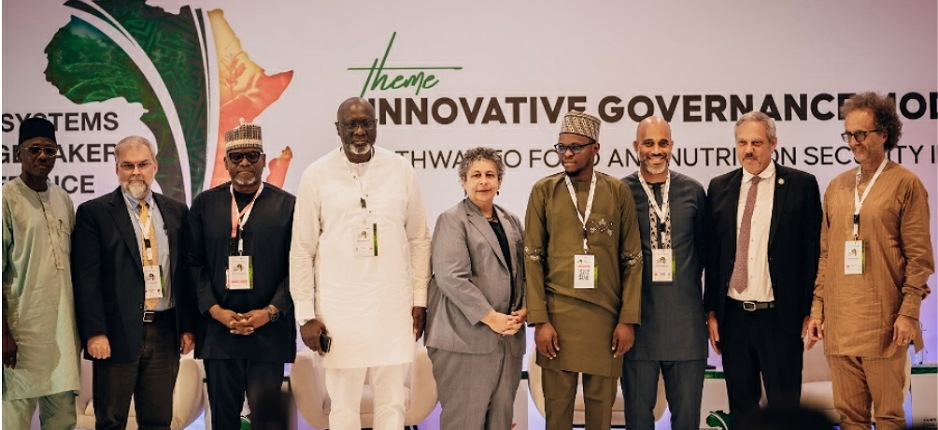
Top agricultural experts converged in Abuja on Thursday for the Sahel Food Systems Changemakers Conference (SFSC), issuing stark warnings about the worsening food and nutrition insecurity across Nigeria and the African continent.
Themed “Innovative Governance Models: A Pathway to Food and Nutrition Security in Nigeria,” the high-profile event exposed the cracks in Nigeria’s food systems, as skyrocketing inflation, climate disasters, and inconsistent policies tighten their grip on millions of vulnerable citizens.
Hosted by Sahel Consulting Agriculture and Nutrition Limited, in collaboration with the Federal Ministry of Agriculture and Food Security (FMAFS), the conference pulled together key players from agriculture, development, and media sectors to discuss urgent reforms.
“We Need Governance Innovations or Face a Food Security Collapse”
Temitope Adegoroye, managing partner at Sahel Consulting, set the tone for the event by warning of imminent disaster if governance structures remain broken.
“Inefficient governance, bad policies, and weak collaboration have crippled our food systems. Without innovative models for evidence-based decision-making, food security in Nigeria will remain a distant dream,” Adegoroye said, signaling a call to action for both public and private stakeholders.
He emphasized that climate change is no longer an abstract threat but a present reality—one that is driving food prices sky-high, slashing agricultural yields, and exacerbating poverty nationwide.
Nigeria’s Food Crisis: Inflation and Hunger Soar Under Tinubu’s Government
The food security crisis has deepened since President Bola Tinubu removed petrol subsidies and floated the naira, triggering hyperinflation. In September 2024 alone, Nigeria’s food inflation rate hit 37.77%, according to the National Bureau of Statistics (NBS)—a jump from 30.64% in the same period last year.
The World Bank recently ranked Nigeria as the fifth hardest-hit nation by food inflation worldwide and third in Africa, trailing only Malawi and Liberia. The country now teeters on the brink of a humanitarian catastrophe, with 26.5 million Nigerians projected to face severe food insecurity in 2024, up from 18.6 million last year.
Adding to the crisis, recurrent floods, land degradation, and erratic weather continue to devastate crop production and disrupt food supply chains, leading to widespread farm closures and business shutdowns.
“We Can’t Keep Reinventing the Wheel” — Experts Push for Continuity and Accountability
At the conference, Tony Bello, chairman of Shine Bridge Global Inc., criticized successive governments for their lack of continuity and failure to sustain agricultural initiatives.
“Every administration shouldn’t try to start from scratch. Let’s carry forward best practices instead of abandoning them. It’s not rocket science,” Bello urged, calling for institutional mechanisms to monitor progress and streamline taxes that stifle agricultural businesses.
Bello also stressed the untapped potential of cassava, one of Nigeria’s major crops. “We need to fortify local flours, create industrial ingredients, and leverage existing infrastructure,” he said, pushing for closer collaboration between the government and private sector to unlock value across agricultural chains.
The Global Hunger Index (GHI) 2024 paints a dire picture of Nigeria’s food situation, ranking the country 110th out of 127 nations with a “serious” hunger score of 28.8 points. Experts at the conference underscored the urgency of addressing systemic issues, including post-harvest losses, poor seed quality, and lack of investment in climate-smart agriculture.
In his remarks, Stephen Oludapo, acting executive secretary of the Seed Entrepreneurs Association of Nigeria (SEEDAN), warned farmers to invest in quality seeds or risk poor yields. “Seeds carry the genetic potential for meaningful production. No matter how good your inputs are, without quality seeds, it’s wasted effort,” he said.
Aisha Hadejia, a partner at Sahel Consulting, showcased Nigeria’s indigenous food products at the conference, emphasizing that local solutions are key to tackling food insecurity. “We must put our local, nutritious food forward. If we don’t, we’ll never get anywhere,” she said.
Hadejia urged producers to form cooperatives to strengthen bargaining power and access financial resources. Similarly, Fisayo Kayode, a senior manager at Sahel Consulting, advocated for government collaboration with private companies to invest in agricultural extension services and train farmers on climate-smart techniques and sustainable post-harvest handling.
The experts unanimously called for swift government intervention to halt the food security crisis spiraling out of control. “Development actors and the private sector must step up. There’s no time to waste,” Adegoroye warned, reaffirming Sahel Consulting’s commitment to turning ideas from the conference into practical solutions.