



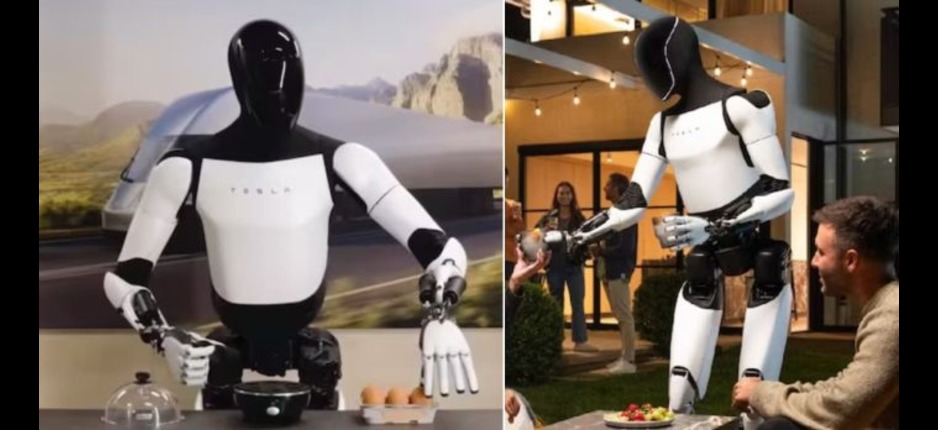
Report says Elon Musk has officially unveiled Tesla's next-generation humanoid robot, Optimus, at the highly anticipated "We, Robot" event, marking a significant milestone in the evolution of robotics. With Musk’s ambitious vision, he claims that the capabilities of Optimus are virtually boundless, setting the stage for a new era in how humans interact with machines.
According to the report, Musk also showcased two new autonomous vehicle models: the Cybercab robotaxi and the Robovan. These innovations are part of Tesla’s broader strategy to integrate advanced artificial intelligence into everyday life, making tasks easier and more efficient.
Musk emphasized the transformative potential of Optimus, stating that it “can do anything you think of.” He illustrated this point by listing a range of everyday tasks that the robot could handle, including walking dogs, babysitting children, mowing lawns, and serving drinks. This versatility could significantly enhance daily living for many people, making Optimus a valuable addition to households everywhere. Priced between $20,000 and $30,000, Musk boldly proclaimed it as “the most significant product ever created,” suggesting that he envisions a future where every person might own an "Optimus buddy."
In a recent demonstration of the Optimus Gen 2, the robot showcased its capabilities by folding shirts and walking with an impressively human-like gait. While many observers were captivated by the robot’s lifelike movements, others expressed mild unease, as the technology blurred the line between human and machine. The Gen 2 version represents a significant upgrade over earlier prototypes, boasting faster walking speeds, improved hand mobility, and advanced tactile sensors, which enhance its ability to interact with objects in its environment.
Tesla first introduced the concept of the Optimus robot, also known as the Tesla Bot, during its AI Day in 2021. The initial goal was to develop a versatile machine capable of taking over tasks deemed dangerous, repetitive, or monotonous for humans. Since that time, Tesla has made steady progress, showcasing numerous updates and advancements in the robot’s functionality. Earlier prototypes were able to perform basic tasks like walking and picking up objects, laying the groundwork for the more sophisticated capabilities of the latest version.
In addition to the Optimus announcement, Musk unveiled the Cybercab, a groundbreaking fully autonomous vehicle that eliminates traditional controls like steering wheels and pedals. Designed to provide a more cost-effective transportation option than public transit, the Cybercab aims to reshape how people think about commuting. Production of this innovative vehicle is expected to commence in 2026, with plans for unsupervised self-driving capabilities to begin rolling out in Tesla's fleet as early as next year in select states.
The combination of Optimus and the Cybercab highlights Tesla's commitment to pushing the boundaries of technology and its potential to redefine everyday life. As these innovations progress, the impact of artificial intelligence on our daily routines will become increasingly apparent, heralding a future where intelligent machines become an integral part of our lives.