


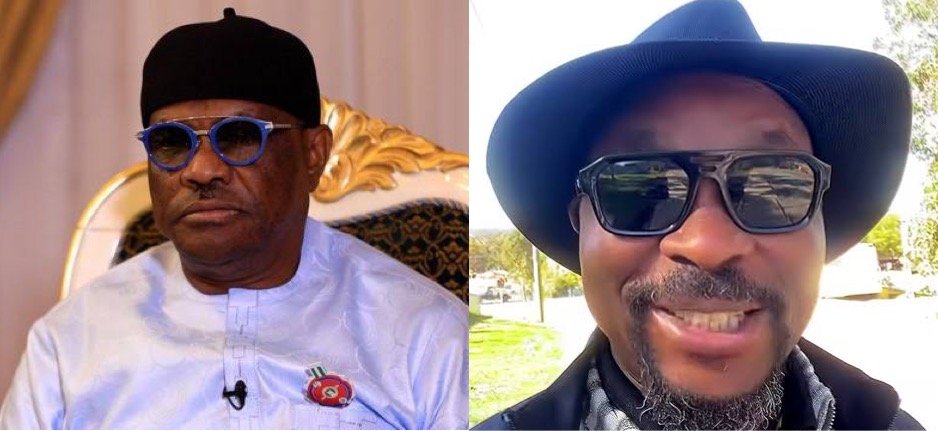
Isaac Fayose, a notable social media commentator and younger sibling of former Ekiti State Governor Ayo Fayose, has raised eyebrows by challenging Nyesom Wike, the Federal Capital Territory (FCT) Minister and former Governor of Rivers State. In a provocative video shared on his social media late yesterday, Fayose suggested that if Wike truly believes in his political power, he should demonstrate it by defecting to the All Progressives Congress (APC).
Fayose’s statement comes at a time when rumors swirl about Wike’s shifting political loyalties and the future of his influence within Nigeria’s complex political landscape. Once a formidable force within the People’s Democratic Party (PDP), Wike has recently forged a close relationship with the APC-led federal government, sparking debates about his true political strength.
Fayose, however, seems unconvinced that Wike’s current influence is built on a solid foundation. According to Fayose, Wike’s political relevance appears more tied to federal support than to grassroots backing. He argues that if Wike were to join the APC, his political influence could plummet by as much as 80%, revealing the fragility of his standing without the leverage of federal patronage.
In making this claim, Fayose is drawing attention to a critical question: Is Wike’s rise in Nigerian politics genuinely reflective of popular support, or is it merely the result of strategic alliances with those in power? Fayose’s skepticism hints at a broader critique of Wike’s political trajectory, suggesting that his prominence may owe more to tactical positioning within the federal government than to enduring popularity among the electorate.
To further emphasize his point, Fayose draws a comparison between Wike and Rotimi Amaechi, another former PDP heavyweight who switched allegiances to the APC after encountering internal party challenges. By referencing Amaechi’s defection, Fayose is effectively calling Wike to prove whether his political stature is truly formidable or merely a byproduct of federal backing.
This exchange highlights the ongoing tension within Nigerian politics, where shifting loyalties among prominent figures continue to raise questions about the true sources of political power. Fayose’s bold challenge to Wike is not just a critique of his current position, but a broader commentary on how party dynamics and federal influence shape the careers of key Nigerian politicians.
At its core, Fayose’s remarks reflect a desire to test the depth of Wike’s political influence—whether it is a product of genuine popular support or merely a temporary advantage gained through strategic alliances. This challenge underscores the fragile nature of political power in Nigeria, where shifts in allegiance can dramatically alter one’s political fortunes.