


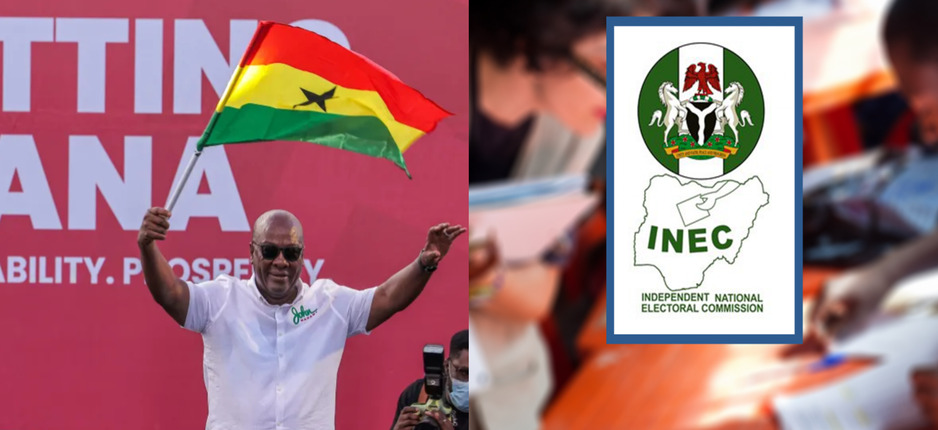
The recent presidential election in Ghana has served as a powerful reminder to Nigeria’s Independent National Electoral Commission (INEC) and the National Assembly (NASS) of the urgent need to overhaul our electoral process. Ghana’s election, which was conducted on a Saturday, saw results delivered by Sunday morning, allowing the ruling party to concede defeat almost immediately. This efficiency, driven by the use of advanced technology, should push us toward adopting similar practices in Nigeria to enhance the credibility, transparency, and speed of our elections.
One of the key takeaways from Ghana's election is the critical role of technology in electoral processes. The swift announcement of results in Ghana was not a coincidence but the result of efficient and effective technological integration. In contrast, Nigeria’s elections often face delays, with results taking days, sometimes weeks, to be fully collated and declared. This delay raises questions about the integrity of our electoral process. There should be no reason why results cannot be uploaded in real-time, as promised with the IREV (Result Viewing Portal), and why some officials still rely on manual processes that delay the announcement of results.
It is imperative that INEC embraces technology fully to ensure real-time transparency and accountability. Any election that fails to meet this technological threshold should be nullified. The risk of result manipulation through the sabotage of technology must be aggressively discouraged and prevented, as this undermines public trust in the electoral system.
Some might argue that Ghana, being a smaller country, can afford to execute its elections more quickly than Nigeria. However, even in state elections in Nigeria, results are not as swift as those in Ghana. If Ghana, with its smaller population, can achieve this level of efficiency, there is no reason why Nigeria, Africa’s most populous country, cannot do the same on a larger scale.
INEC must take a critical look at its internal systems and arrangements, ensuring that it is equipped to fulfill its constitutional duties efficiently and transparently. Additionally, the National Assembly should urgently revisit our electoral laws and amend them where necessary to eliminate ambiguities and strengthen the electoral framework. These laws must be updated to facilitate the delivery of transparent, fast, and credible elections that reflect the true will of the people.
The recent election in Ghana not only serves as an inspiration but also as a challenge to Nigeria. We must learn from their example to reform our electoral processes and ensure that Nigeria continues to lead the continent in democratic values.
Finally, while we work toward these improvements, it is important to congratulate the people of Ghana for their smooth transition of power, which further underscores the importance of a robust, technology-driven electoral process.