



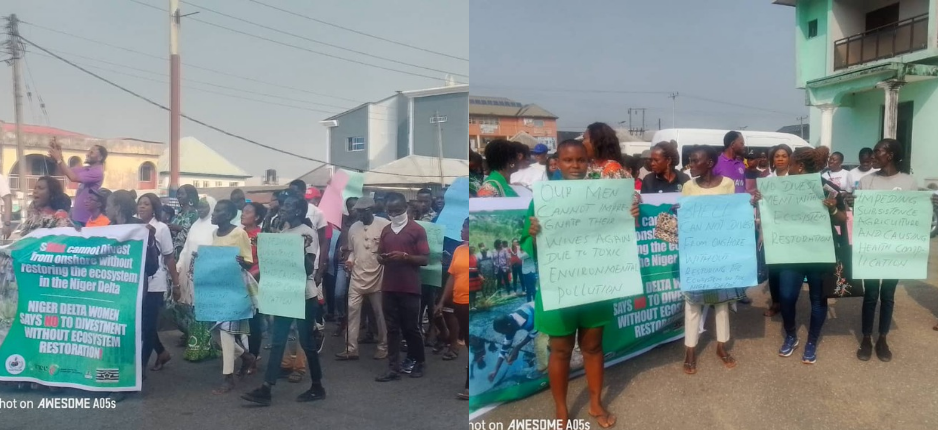
Women from Bayelsa State and other parts of the Niger Delta took to the streets on Friday, protesting the planned sale of Shell Petroleum Development Company's (SPDC) Nigerian subsidiary and other oil multinationals' assets.
The women, who marched to the Nigeria Union of Journalists (NUJ) Press Centre in Yenagoa, demanded that the companies clean up decades of pollution caused by their activities and restore the region's devastated ecosystem before any divestment takes place.
They demanded that the companies must first clean up decades of pollution caused by their activities and restore the region's devastated ecosystem.
The women lamented that the toxic pollution has not only destroyed their environment but also harmed reproductive health, with some claiming that men in the region are no longer able to impregnate their wives due to prolonged exposure to the contamination.
The women however called on the Federal Government to deny oil companies the approval to divest until they clean up the polluted environment in the Niger Delta.
While presenting their position paper, signed by Mrs. Emem Okon of Kebetkache Women Development and Resource Centre alongside over 15 women groups in the region, to representatives of the Nigeria Union of Journalists, the protesters condemned Shell’s plan to sell its Nigerian subsidiary, Shell Petroleum Development Company (SPDC), and its onshore assets without engaging with the affected communities.
The protesters slammed Shell's planned sale of its Nigerian subsidiary, Shell Petroleum Development Company (SPDC), as "unethical, irresponsible, and unacceptable."
Barrister Dise Ogbise-Goddy of the Do Foundation condemned Shell's actions as a gross injustice, stressing that the company must restore the devastated ecosystem in the Niger Delta before divesting.
She said: “Shell plans to sell SPDC shares to Renaissance Africa Energy, a consortium of investors, without regard for its legacy of environmental damage and the need for appropriate consultation with all stakeholders, remedies, and social and legal license to exit.
“It is instructive that the company has already divested OML 34 to ND Western; OML 17 and OML 29 without proper guidelines. We use this medium to call on the federal government not to approve Shell’s planned sale of oil assets in Nigeria until all polluted farmlands in the Niger Delta have been cleaned and restored by these companies.
“The story is similar with other oil majors in Nigeria. Nigeria Agip Oil Company (NAOC), Exxon Mobil Nigeria Limited, and Total Energy Nigeria Limited are poised to divest their onshore assets without engaging host communities and rectifying the damages done to their environment and the well-being of people.
“As affected Niger Delta women, we are concerned about the swiftness of these divestment plans because the government has not provided guidelines to resolve pollution issues before SPDC, AGIP, and Total Energies leave. The companies involved have failed to create women development funds to help victims of oil extraction. Women in the Niger Delta suffer severe environmental consequences of oil extraction.
“Women are concerned because the reputations of the new corporations acquiring SPDC, AGIP, and Exxon Mobil assets are unknown to them. In addition, gas flaring in Ebocha, Ibeno, Umuechem, and other regions has continued as of this instant; communities such as Otuabagi continue to endure the repercussions.
“The severe disruption to agriculture, fishing, and hunting has caused health issues among women who have been exposed to hydrocarbons. The planned divestment has not considered the interests of community people, particularly women.
“Renaissance Africa Energy should make public all documents submitted for the acquisition of SPDC and all proofs of compliance with the so-called checklist and guidelines for divestment of oil assets.
“The Federal Government should not approve the divestment of oil assets until all polluted farmlands, rivers, air, and forests in the Niger Delta have been cleaned and restored", She said.
Also, Some women like Mrs. Joy Suoye and Inise Siba Daniel from Otuoabagi Community, home to the historic Oloibiri oilfield, recounted how decades of environmental pollution have inflicted severe health challenges on the people of their community.