

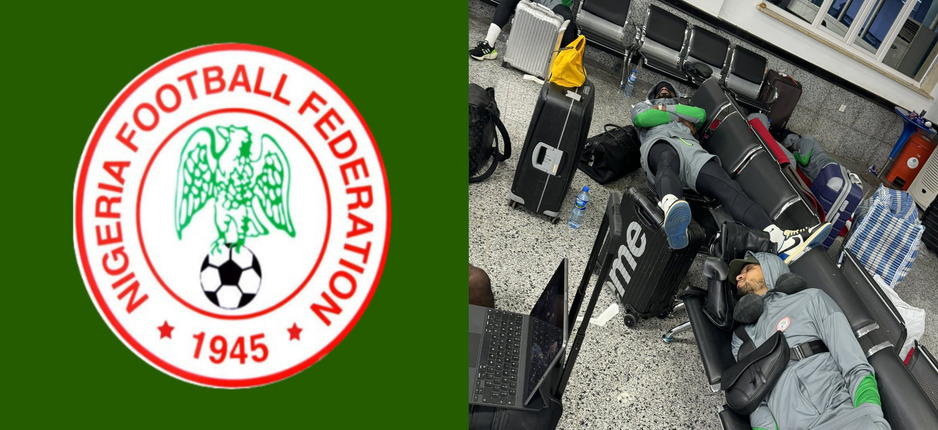
In a shocking turn of events, Nigeria's Super Eagles have officially pulled out of their upcoming African Cup of Nations (AFCON) qualifying match against Libya, following an excruciating 12-hour ordeal at Al Abraq International Airport.
The team, en route to Benghazi for a crucial qualifier, faced a harrowing diversion to the remote Al Abraq airport—a facility usually reserved for Hajj operations—leaving players and officials stranded without any support from the Libyan Football Federation. Upon arrival on Sunday afternoon, they found themselves trapped in a nightmarish scenario, with no transportation or basic amenities provided.
The Nigerian Football Federation (NFF) expressed outrage over the situation, detailing how their chartered ValueJet aircraft was inexplicably redirected just as the pilot prepared for landing in Benghazi. “Twelve hours after landing, the delegation is still at Al Abraq Airport, unable to reach our hotel, which is three hours away,” the NFF lamented.
With players growing increasingly fatigued and frustrated, the team made the difficult decision to withdraw from the match altogether. “Players have resolved not to play any longer, and NFF officials are making plans to fly the team back home,” the statement concluded.
Super Eagles captain William Troost-Ekong did not hold back in his condemnation of the Libyan authorities. In a series of impassioned tweets, he labeled the situation as “disgraceful,” accusing Libyan officials of engaging in “mind games.” He described the dire conditions at the airport, stating, “We are in an abandoned airport without food, drink, or phone connections.”
Troost-Ekong highlighted the plight of the team as they remained locked in the airport, with no explanation given for the sudden change in their landing rights. “I’ve faced issues while playing away in Africa, but this is disgraceful behavior,” he asserted.
The captain also raised concerns for the Tunisian pilot, who successfully navigated the crisis but was denied accommodation for his crew under government orders, forcing them to sleep on the plane while the pilot could at least rest at the airport. “The pilot had never seen anything like this before,” Troost-Ekong noted.
In light of these circumstances, Troost-Ekong expressed serious safety concerns about traveling by road in Libya and questioned the quality of accommodations the team might receive. “We respect ourselves and our opponents. Mistakes happen, but these deliberate actions have nothing to do with international football,” he stated firmly.
Former Super Eagles player Leon Balogun has also called for the Confederation of African Football (CAF) to take stringent action against Libya for their mistreatment of the Nigerian team.
The Super Eagles arrived in Libya hoping to build on their 1-0 victory from the first leg of the AFCON qualifying tie held in Uyo. However, with the CAF yet to respond to this unfolding crisis, the situation remains precarious, leaving fans to wonder about the future of Nigerian football on the continental stage. As the football community awaits further developments, one thing is clear: the treatment of the Super Eagles is a matter that transcends sports, calling for urgent action a nd accountability.