



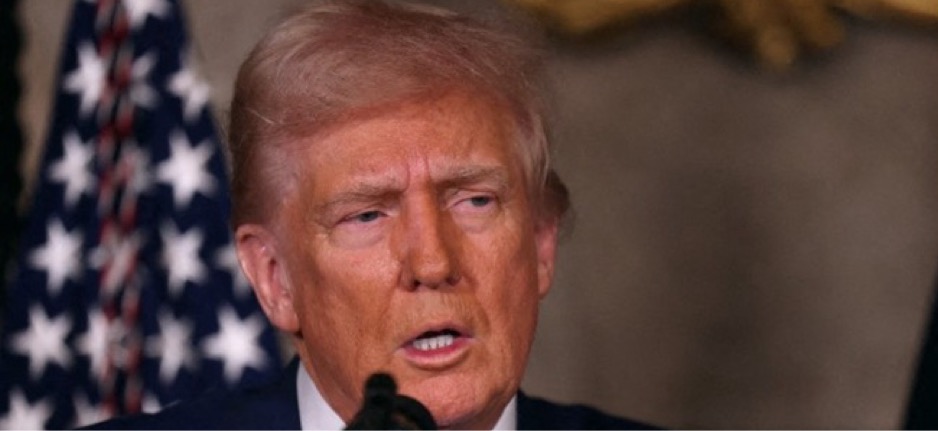
President Donald Trump officially designated English as the United States official language, emphasizing that the move would promote unity in a nation shaped by diverse immigration.
In an executive order released on Saturday, Trump stated that it was “long past time” for English to be formally recognized as the primary language of the country. The order asserts that a common language is essential for fostering national cohesion and strengthening communication among citizens.
“A nationally designated language is at the core of a unified and cohesive society, and the United States is strengthened by a citizenry that can freely exchange ideas in one shared language,” the document reads.
This new directive overturns a policy from the 1990s, introduced by then-President Bill Clinton, which required federal agencies and federally funded organizations to provide assistance to non-English speakers. Under the revoked mandate, government offices were obligated to offer services in multiple languages to ensure accessibility for individuals with limited English proficiency.
While the executive order establishes English as the nation’s official language, it does not completely eliminate language assistance for non-English speakers. Instead, it allows government agencies to determine the extent of multilingual support they will continue to offer.
“Nothing in this order, requires or directs any change in the services provided by any agency,” the document clarifies. Rather, it grants agency leaders the authority to assess their specific needs and decide what is necessary to fulfill their missions while efficiently serving the American public.
The announcement has sparked debate across the country, with supporters arguing that it reinforces national identity and simplifies government operations. Advocates believe that prioritizing English will encourage linguistic assimilation and reduce costs associated with translation and interpretation services.
However, critics view the decision as exclusionary, pointing out that it may create barriers for millions of non-English speakers who rely on government services. They argue that language accessibility is crucial in sectors such as healthcare, education, and legal assistance, and reducing multilingual support could disproportionately affect immigrant communities.
As discussions continue, the policy’s long-term impact remains uncertain. While the executive order marks a significant shift in federal language policy, its practical effects will largely depend on how individual agencies choose to implement the new guidelines.