


The Bayelsa State primary school system is in dire straights, suggesting that there is a gross shortage of teachers at that level of education in the state.
Shortage of teachers is a huge burden on the government because it calls for the conduct of recruitment exercise, planning and posting of teachers and the extra funds for payment of the newly-recruited teachers.
Ironically, shortage of teachers is not even the problem! The real issue is the inequitable distribution of teachers in appropriate schools and areas of need.
To put an end to this problem, the state government has given assurance that it will do everything in its power to ensure equitable distribution of teachers in primary schools in the state.
Presently, while some urban primary schools are over-staffed, with some having as many as 80 teachers, schools in rural areas are grossly under-staffed with as few as eight or 12 teachers and thus acutely accentuating the incidence of very poor teacher/student ratio in such rural schools.
Disturbed by this development, the Bayelsa State Government has taken concrete steps to remedy the disturbing situation by setting up a Teachers Redistribution Committee.
The Committee, headed by the Deputy Chief of Staff to the Governor, Mr Irorodamie Komonibo, is saddled with the responsibility of collecting, sorting and analysing available data with a view to equitably distributing teachers to all public primary schools across the eight local government areas of the state.
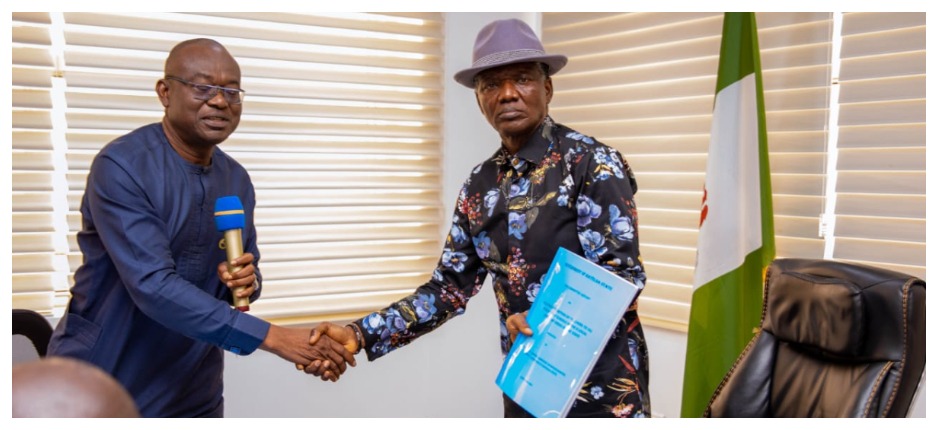
While receiving the report of the Teachers Redistribution Committee in his office at Government House, the state Deputy Governor, Senator Lawrence Ewhrudjakpo said government would liaise with the benefitting communities where teachers would be posted to so that such communities can monitor the whereabouts of teachers, with a view to reporting absentee teachers to relevant authorities, where necessary.
According to Senator Ewhrudjakpo: "Now that this report is out, I will meet with the various schools and community leaders, possibly ward by ward and hand over the list of teachers posted to them. They have to monitor the teachers".
The Deputy Governor, who expressed gratitude to the committee for doing a thorough job, said the report had justified his long-held position that the Bayelsa public primary school system was mainly suffering from lopsidedness in teachers distribution and not necessarily a dearth of teachers.
While warning teachers against truancy, he assured that the present administration would implement all the relevant and necessary recommendations contained in the committee's report that will enable the state government achieve its set goals in the education sector.
During the presentation of the Committee's report, the Chairman, Mr Irorodamie Komonibo, advised government to formulate and adopt a uniform nominal roll to be used by all public primary schools in the state.
The chairman said the committee has already provided a standard and reliable format of nominal roll for schools to ease the process for future teacher redistribution and verification exercises.
The Committee strongly prescribed that there was need for government to closely monitor the incidences of frequent teacher absenteeism and teachers abandoning their duty post to address the problem of inequitable distribution of teachers which usually result in lopsidedness and supply gaps in schools.
According to the Committee, "There is need to train officers working in education organs to be abreast with the intricacies of posting, redistribution and reassignment of teachers to ensure equity and fairness to enhance adequate and effective utilization of teachers in schools.
The Committee equally recommended to government to ensure that appointment and posting of head teachers should be carried out only by the state Universal Basic Education Board (SUBEB), and not by the different Local Government Education Authorities (LGEAs), to correct existing anomalies.
"Service records of all teachers should be updated to avoid errors. To achieve this, a comprehensive re-verification of all public primary school teachers is recommended for immediate action," the committee added.
It is a welcome development that the Bayelsa State Government is taking steps to address the issue of lopsided distribution of teachers in the state public primary schools but for the initiative to work and have an equitable distribution of teachers in public primary schools, there are one or two things the state government has to do.
One of the causes of inequitable distribution of teachers in primary schools in Bayelsa State is the lack of social amenities in rural schools, which leads to teachers rejecting posting to rural schools. Once the teachers are posted to village schools, they go to any other LGEA, maybe a sub-urban LGEA, with level of amenities, "sort out" the relevant officials. No LGEA is aware of what is happening in the other LGEAs so teachers can do whatever they like and get away with. It was to prevent issues like this that the Teachers Redistribution Committee recommended to government to ensure that appointment and posting of head teachers should be carried out only by the state Universal Basic Education Board (SUBEB), and not by the different Local Government Education Authorities (LGEAs), to correct existing anomalies.
In an interview with our reporter, a teacher who retired from Government Comprehensive Secondary School (GCSS), Tungbo (now Federal Government Technical College, Tungbo) in Sagbama Local Government Area of the state, Deli Joseph, said, "Teachers refuse posting to rural areas, particularly riverine communities, because of the lack of social amenities in such rural communities. While one can appreciate, and sympathise with such affected teachers, it is important for the teachers to think about the welfare of pupils in rural schools".
If everybody refuses to accept rural posting, who will teach the children in the villages, Mr Joseph asked rhetorically.
Besides rejecting posting to rural areas, some teachers actually accept the postings alright but they will refuse to go to work. In connivance with the head teachers, they stay at home and receive salaries for doing nothing.
There are cases of teachers who manage to put up appearance at school maybe once a week and the other days of the month they are at home. At the end of the month they "sort" their head teachers and this goes on for years with the pupils suffering the brunt.
Continuing, Deli Joseph said "Good as the threat by the state government is, the relevant authorities must make effort to make the rural schools a bit more conducive to stay. For instance, government could build staff quarters for members of staff, especially those who are not indigenes, to stay. In addition to staff quarters, government should make effort to provide boreholes and rural electrification. This will certainly be attracted to remain in rural communities".