


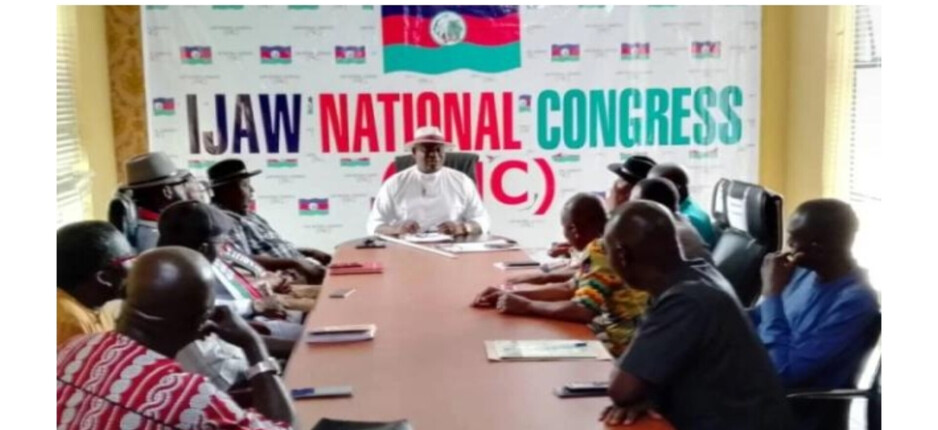
The Ijaw National Congress (INC) has strongly condemned the Supreme Court's recent ruling, which annulled the local government elections in Rivers State, raising concerns about its potential impact on the peace and stability of the Niger Delta region. The INC also warned against any attempts to impeach Rivers State Governor, Siminalayi Fubara, emphasizing that such an action could destabilize the oil-rich region and disrupt national economic stability.
The INC expressed deep concern that the Supreme Court’s decision, which confirmed the 27 lawmakers loyal to Nyesom Wike, Minister of the Federal Capital Territory, as legitimate members of the Rivers State House of Assembly, could lead to unrest in the region. The congress, represented by its president, Professor Benjamin Okaba, highlighted the risk of political marginalization of the Ijaw people in Rivers and neighboring states, further exacerbating tensions in the Niger Delta.
In a statement made available to journalists, Prof. Okaba noted that the Ijaw people in Rivers State must not be sidelined politically, pointing to a broader issue of exclusion that extends to other states like Ondo, Edo, Delta, and Akwa Ibom. He stressed that the Supreme Court's decision did not fully recognize the significant contributions of the Ijaw people to the political development of Rivers State.
"The Ijaw people have made historical and political sacrifices for the leadership of Rivers State. In 1999, Ijaw leader Chief Marshall Harry played a pivotal role in securing the Peoples Democratic Party (PDP) ticket for Dr. Peter Odili, against fierce opposition," Okaba stated. He recalled how the Ijaw people, through various leaders, have been instrumental in shaping the political landscape of the state over the years, only to now face exclusion at a critical time.
Prof. Okaba continued to recount the series of sacrifices made by the Ijaw people, including the assassination of Marshall Harry in 2003, and the crucial role played by Ijaw leaders such as Soboma George and Farrah Dagogo in securing political victories for other prominent figures in the state. "Despite these efforts, the current political elite from the Ikwerre ethnic group seems determined to frustrate the emergence of Governor Fubara, the first riverine governor in decades," he lamented.
The INC President affirmed the Ijaw nation's readiness to defend Governor Fubara, stating that they would protect his mandate with "every pint of blood in their veins." He warned that the ongoing political crisis in Rivers State, if left unresolved, could reignite tensions in the Niger Delta, which had only recently stabilized after years of unrest.
The Ijaw Congress leader further stressed that the peace and economic prosperity of the Niger Delta, particularly with regard to oil production, have been the result of the region's commitment to maintaining stability. However, he accused the political establishment of using the very resources generated from the region to marginalize the Ijaw people.
Prof. Okaba called on President Bola Tinubu to intervene in the escalating crisis, urging him to treat the matter as one that goes beyond routine politics. He reminded the government that the Ijaw people, numbering over 40 million globally, would not tolerate any attempts to diminish their influence in Nigerian politics.
The Supreme Court ruling that has stoked this political firestorm placed a financial restriction on the Rivers State Government, preventing the Central Bank of Nigeria, the Accountant General of the Federation, and other government agencies from releasing funds to the state until Governor Fubara complies with previous court orders. This ruling is part of a wider judgment delivered by Justice Emmanuel Akomaye, which criticized the Rivers State Government for ignoring prior legal directives.
Governor Fubara's administration faced further legal setbacks as the court rejected his challenge against the leadership of the Rivers State House of Assembly under Speaker Martin Amaewhule. The court upheld the legitimacy of Amaewhule and directed him and the other lawmakers to resume legislative duties immediately.
One of the key points of contention was Governor Fubara’s decision to present the state’s appropriation bill to a four-member assembly, bypassing 28 other lawmakers. The Supreme Court called this a violation of legislative norms, accusing Fubara of authoritarian tactics to obstruct the legislative process.
The ruling also addressed the controversial local government elections held in October 2024. Justice Jamilu Tukur declared the election process null and void, citing widespread violations of the Electoral Act by the Rivers State Independent Electoral Commission. These included continued voter registration even after the official announcement of the election date, which the court deemed a significant breach of electoral guidelines.